
The Sweet Spot: Supporting Stable Glucose in Pregnancy
When we talk about blood sugar during pregnancy, most people immediately think about gestational diabetes. But healthy glucose regulation matters in every pregnancy.
Blood glucose is one of the primary fuels your body uses for energy, and glucose crosses the placenta to provide energy for your growing baby. Pregnancy is the ideal time to really understand (and embrace) the importance of stable blood glucose.
Your top goal for blood sugar: steady, well-regulated glucose without repeated big spikes or uncomfortable drops. Spikes and drops can make you feel terrible! Steady glucose is the sweet spot for feeling healthy, strong, and having good energy for mom, and steady healthy growth for Baby.
What Does Unstable Blood Sugar Feel Like?
Blood sugar doesn't have to be extremely high or extremely low before you notice changes in how you feel.
A blood sugar drop may feel like:
Shakiness
Weakness
Lightheadedness
Sudden hunger
Nausea
Headache
Sweating
Feeling anxious or jittery
Heart pounding
Irritability
Difficulty concentrating
Sudden fatigue
Some people describe feeling completely fine and then suddenly feeling as though they have to eat immediately.
On the other side, a large rise in glucose followed by a drop can leave you tired, foggy, hungry or craving another quick source of carbohydrate. This is one reason we encourage pregnant people to think about blood sugar stability, not simply whether they "passed" their gestational diabetes screening.
Blood Sugar and Your Baby
Pregnancy requires adequate calories, carbohydrates, protein, healthy fats, vitamins and minerals to support fetal growth.
Our goal is: Enough nourishment for pregnancy without repeatedly flooding the bloodstream with sugar and then crashing afterward. Balanced meals and regular eating can help accomplish that.
What is My Blood Sugar?
There are two useful ways to gather information.
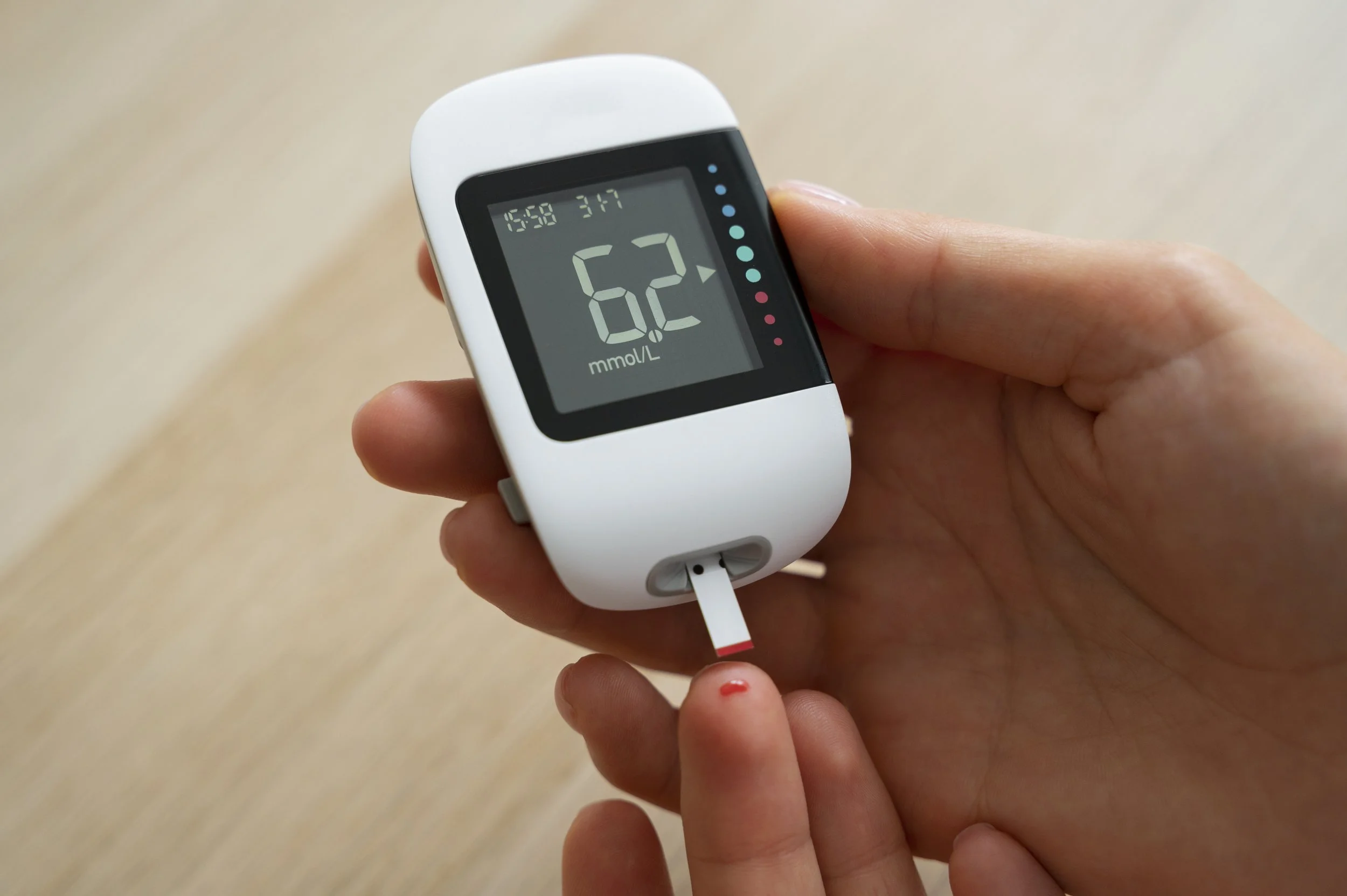
Glucometer - Measure Fasting and 1-hour after meals
Option 1: A Finger-Prick Glucometer
A standard glucometer is inexpensive and gives you a snapshot of your glucose at specific times. You can pick one up on Amazon. One brand we have used that came with both the reader and the strips is FreeStyle Libre Glucose Meter.
You can poke your finger and put 1 drop of blood on the test strip 4x a day:
Fasting: Check your glucose when you first wake up, before eating or drinking anything containing calories. (The number you get should be between 70- 95 mg/dL)
After meals: Check your glucose one hour after the beginning of breakfast, lunch and dinner. Your glucose should be less than 140 mg/dL
Option 2: Continuous Glucose Monitoring

Continuous Glucose Monitoring shows you a continuous trend
Another option is a continuous glucose monitor, or CGM. A CGM is a small sensor worn on your body that measures glucose throughout the day and night.
Instead of seeing four individual numbers, you see a graph. That can be especially helpful because sometimes the most interesting information isn't the highest number — it's the pattern, and what happens in the middle of the night. The other great thing about CGM’s is if you are feeling “off” in your body, you can look at your glucose and see if the sensations/ symptoms you are experiencing are related to your glucose.
A CGM can show:
What happens after breakfast compared with dinner
Which foods cause larger glucose increases
Whether adding protein changes the response
Whether glucose rises and then crashes quickly
What happens while you're sleeping
Whether glucose drops during the night
Whether your fasting glucose begins rising before you wake up
How exercise affects glucose
How long it takes your glucose to return toward baseline after a meal
CGMs are well established for managing diabetes in pregnancy. Their routine use in pregnant people without diabetes hasn't been established as necessary, so in this setting we are primarily using the information to understand patterns, rather than diagnosing disease from every rise or dip on the graph.
And remember: CGMs measure glucose in interstitial fluid rather than directly from the bloodstream, so an unexpected low or high reading can sometimes be worth confirming with a finger-stick glucose measurement.
A Quick Review of Nutrition
One of the simplest ways to improve glucose stability is to make sure you are eating enough protein.
The standard recommended dietary allowance during pregnancy is approximately 80 grams of protein per day, although individual protein needs vary with body size, activity level and pregnancy circumstances.
In our practice, many clients find that aiming for approximately 100 grams of protein per day makes it easier to build satisfying meals, maintain steady energy and avoid meals that are predominantly carbohydrate.
You can usually reach the 80-100 gram protein target by eating a meat / protein at breakfast, lunch and dinner. If one of your meals is a little light on protein, just add a good protein snack.
A Simple 100-Gram Protein Day
Breakfast — approximately 25 grams
Example:
2 eggs — 12 g
½ cup cottage cheese — 12–14 g
Berries or another fruit
Morning snack — approximately 10 grams
Example:
Greek yogurt
or
Cheese with an apple
or
Nuts plus a cheese stick
Lunch — approximately 25 grams
Example:
3–4 ounces chicken, turkey, beef or fish — approximately 22–28 g
Large salad or vegetables
Avocado or olive-oil dressing
Beans, quinoa, potatoes, fruit or another carbohydrate as desired
Afternoon snack — approximately 10 grams
Example:
Apple with peanut butter
Hummus with vegetables
Cottage cheese and fruit
Greek yogurt
Boiled eggs
Cheese and whole-grain crackers
Dinner — approximately 25–30 grams
Example:
4 ounces salmon, chicken, beef, pork or turkey — approximately 25–30 g
Vegetables
A healthy carbohydrate such as potatoes, beans, rice, quinoa or whole grains
Healthy fat such as butter, olive oil or avocado
That brings the day to roughly 95–105 grams of protein without requiring unusually large meals.
Don't Eat “Lonely” Carbohydrates
You do not need to eliminate carbohydrates during pregnancy. Carbohydrates provide energy and are part of a healthy pregnancy diet. The pregnancy dietary reference intake includes at least 175 grams of carbohydrate per day. But to make sure they don’t have a huge impact on your blood sugar balance, always pair them with a protein, or eat them after a protein.
Instead, think about what accompanies the carbohydrate.
Rather than:
Toast try Toast + eggs + avocado
Rather than:
Apple try: Apple + peanut butter
Rather than:
Crackers try: Crackers + cheese
Rather than:
Oatmeal with brown sugar try: Oatmeal + nuts + seeds + Greek yogurt
Protein, fat and fiber generally make a meal more satisfying and can slow the absorption of carbohydrate.
A simple rule is:
When you eat a carbohydrate, pair it with protein
Late Night Snacks
Are you waking at 3-4 am? Sometimes that’s a sign your glucose dropped. Are you waking up “starving” in the morning? That’s also a sign your blood glucose was unstable. Try adding a 20-gram protein snack at bedtime. Examples include:
Greek yogurt and berries
Apple and peanut butter
Cheese and whole-grain crackers
Cottage cheese and fruit
Half a turkey sandwich
Nuts with a small piece of fruit
Fairlife protein drinks
Magic of Squats
Your muscles use glucose. Even gentle activity after a meal can help your body move glucose from the bloodstream into muscle cells. So, if you’re seeing higher glucose numbers than you like, try pushing the glucose out of your blood stream into your muscles with light movement. Sumo Squats are one great way to quickly move glucose into your muscles. Try 10-15 squats after every meal.
And, at least once a day, try a 10–20 minute walk after a meal to support healthy glucose regulation (and take a moment to enjoy time to yourself)
When Low Blood Sugar Needs More Attention
Occasional hunger between meals is one thing.
Repeated documented glucose values below approximately 70 mg/dL, particularly when accompanied by shakiness, sweating, confusion, dizziness, weakness or fainting, deserve further evaluation. If you are seeing repeated low values, unusually high values, significant symptoms, inability to eat normally, or an unusual glucose pattern on a CGM, share the readings with your midwife.
The goal isn't simply to correct today's number. We want to understand why it is happening.
The Bottom Line
Healthy blood sugar during pregnancy is not just about avoiding gestational diabetes. It is about providing your body and your baby with a steady supply of nourishment.
Focus on:
Regular meals
Protein throughout the day - 80-100 grams
Healthy fats
Fiber-rich foods
Carbohydrates paired with protein, fat or fiber
Healthy snacks when needed
Adequate hydration - ½ your body weight in ounces
Gentle movement - 10 squats after meals + 30 min walk after dinner
Paying attention to how your body feels
And if something feels off, glucose monitoring gives us another tool to investigate what your body may be telling us.
Pregnancy shouldn't require you to obsess over every bite or every glucose reading.
The goal is simply:
Feed yourself well. Feed yourself regularly. Look for patterns. And aim for steady rather than perfect.
